
When you write a lot of different things, it’s important to know how to balance and differentiate between the different styles required for each type of writing.
Specifically, do you approach blogging in the same way as a magazine article, for instance? Or use the same voice for a novel as you would for web content?
Everything from a tweet to an Instagram post is a public form of writing these days, and if you hope to make a living using many different income streams from different types of writing, it helps to know what’s involved.
The key is approaching each type of writing with a brief in mind, and learning to move and shape your voice to fit that brief. Here’s how I approach different types of writing.
Features writing
Features writing requires voice + objectivity. You are writing for a large, faceless audience who have certain expectations about what they will see in that particular publication. There will be a certain vocabulary that will resonate with that demographic (and you must never forget that each magazine has a specific demographic) and you may find yourself using such terms as ‘BFF’ and ‘vajazzle’, which you would not generally use.
You must also in feature writing make room for expert voices, weaving them in and out, providing a balanced view of whatever your subject may be. Having said that, the essential tenor of the article must remain true to your own style and voice. Easy, huh?
Personal blog
Writing for a personal blog, on the other hand, requires intimacy. Here, it is all about your voice. This is what I love about it. You can truly give voice to your own voice in a way that you can’t when you have an editor, a specified readership and others to please.
Social media
Twitter and other social media has been very good for my writing in a strange way. While it is not good for the attention span, it is superb for clarity. Getting a cohesive message into 280 characters can be a challenge and is a simple way to spot waffle at 20 paces. As for Facebook and Instagram, the perfect post for each is slightly different, which is one reason I don’t autopost from Instagram to Facebook.
Books
Now for books. Ah yes. So many words.
With non-fiction books, I usually break it down into chapters, write each as I would approach a long magazine feature and then work out where I’ve repeated myself so that I can cross-reference and double check. Fun.
Fiction, on the other hand, is a whole different kettle of fish. It comes back to voice – presenting your story in your own words – but also creating characters with their own voices. Not easy. There’s also a lot of persistence involved.
As discussed, I am not a plotter (though I am rapidly appreciating the value of having a map through a story), so I tend to just start and see what will happen.
I find that fiction requires long periods of thinking followed by short bursts of activity. I put down 1000 words here and 500 words there, and then ruminate for a while before banging out another couple of thousand words. I know that many experts say that the best advice is to write every day, but my thinking on that is that I do – just not always on the same project.
I also write for other websites, do corporate work (including newsletters and media releases), and write advertising copy. All of which require different approaches again (which we might go into a different day as I’m getting sick of the sound of my own voice here…).
So, yes, I am constantly switching between forms, but each has a quite specific approach. Sometimes I do find myself wishing that my next magazine feature was 140 characters long – but I have to say that writing short can be a lot more difficult than writing long. Less room to cover up if you get it wrong.
The one thing that carries over in every form of writing is discipline.
Mostly, the discipline to do it.
 Are you new here? Welcome to my blog! I’m Allison Tait and you can find out more about me here and more about my online writing courses here.
Subscribe to So You Want To Be A Writer podcast for more amazing writing advice.
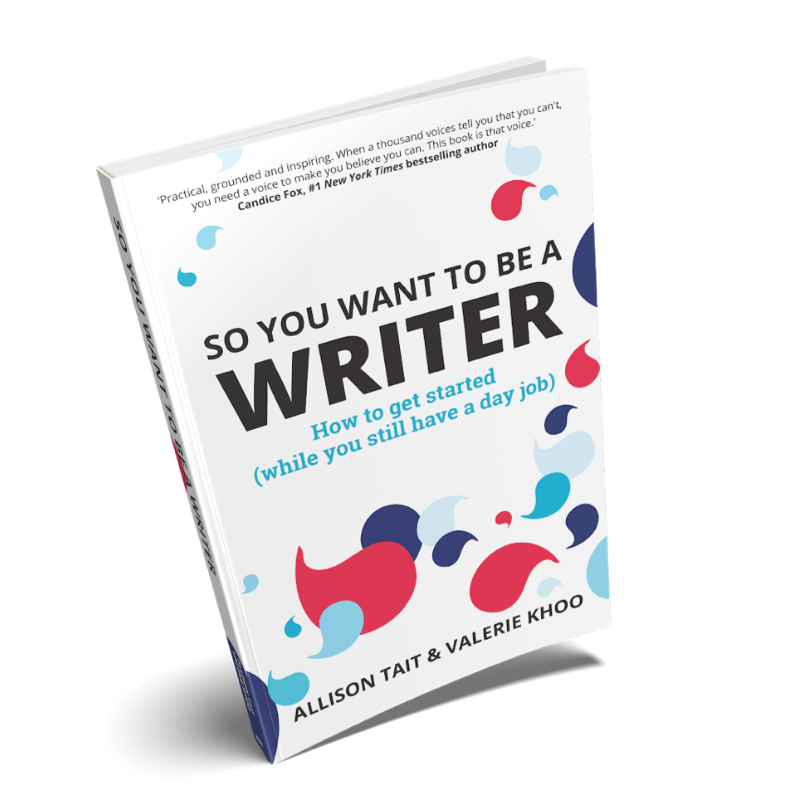
Or check out So You Want To Be A Writer (the book), where my co-author Valerie Khoo and I have distilled the best tips from hundreds of author and industry expert interviews. Find out more and buy it here.

0 Comments