
So when it came time to tackle the thorny question of literary fiction, there was no-one better to turn to. Fortunately for me, she was happy to pop by…
Charlotte Wood on literary fiction, branding and ‘all that junk’
Can you explain the difference between literary fiction and commercial fiction?
Charlotte Wood: “Not really! I guess one broad definition is that literary fiction has traditionally been more concerned than popular fiction with experimental forms of the novel, and with an exploration of language and theme and ideas and so on, placing them on a plane of equal importance with storytelling and plot, etc. But really, these sorts of categories are fast disappearing I think, and often are quite arbitrary. It is one of the many, many things I find bewildering about publishing.”
Did you set out to write literary fiction? Can you tell us a little of your path to first publication?
Charlotte Wood: “No, I didn’t set out to write anything except the kind of book I might like to read. I’m not interested in publishing categories or marketing platforms or whatever, it just gets in the way of writing – the business end of things will do what it does without useful guidance from me.
“The more I publish, the more I think the mechanics of publishing are none of a writer’s business. Our concern is to write a good sentence and excavate the strange and lovely territory of the self – I hope I am getting better at focusing on that as I write, rather than the end result. It’s hard to forget about publication, but after five books I soundly believe that trying to second-guess these things simply doesn’t work. One’s book will be what it is, and it’s up to others to figure out how to best get it to its readers.
“My first publication was bizarrely easy – I worked hard on my book of course, for about three years, and that wasn’t easy at all. But the actual publication bit happened quickly and smoothly – my book was shown to a publisher by an editor I worked with at Varuna, The Writer’s House; I got an agent overnight (also via Varuna), and within two weeks of my finishing the book the deal was done.
“My second book had a more normal experience – rejected by that publisher, but then taken up by the amazing Jane Palfreyman, then at Random House and now at Allen and Unwin. She has been my staunch supporter ever since, and I am incredibly lucky to have her and hope her faith in me continues.”
What made you switch to non-fiction for your last book (Love & Hunger)? Will your next book be fiction or non-fiction?
Charlotte Wood: “I just felt like a break from fiction after Animal People, and the idea of a book about cooking grew fairly naturally out of my blog, How to Shuck an Oyster. That said, most of the book was new material, but the voice came from my blogging voice, which was a delight to write in compared to fiction – easy, intimate, personal.
“But I’m very much hankering now to go back to the murky territory of fiction, which is much more difficult (for me), but also oddly liberating and satisfying. I am working on a first draft of a new novel.”
Authors are told of the importance of ‘branding’ and ‘build platforms’ on the path to publication. What’s your take on this?
Charlotte Wood: “I can only speak for literary fiction (and non-fiction to a lesser degree) because that’s the area in which I work.
“I think writing is your first priority – writing a good sentence, a good paragraph, a good book. This takes years and years of careful, quiet attention. Sometimes I think people like to talk about branding and building platforms because it’s a hell of a lot easier than actually sitting down with the quiet self and writing.
“Writing is hard. I am reminded of a fantastic interview I heard with Jerry Seinfeld recently. He said he was asked all the time about how comedians should promote themselves and network and stuff, and he said he knew of a big comedy convention where people went to learn about this and find agents and so on.
“He said something like, “I wish I ran that convention. I’d go and take down all the stalls and all the sessions and just put up a big sign that says, ‘Go Home and Work.’ Just do the work.”
“I note that two of the most successful Australian literary authors of recent times – Anna Funder and Christos Tsiolkas – have almost no orchestrated online presence, and I can almost certainly bet the notion of ‘branding’ has never crossed their minds. All their energy goes into writing great books – and readers responded.
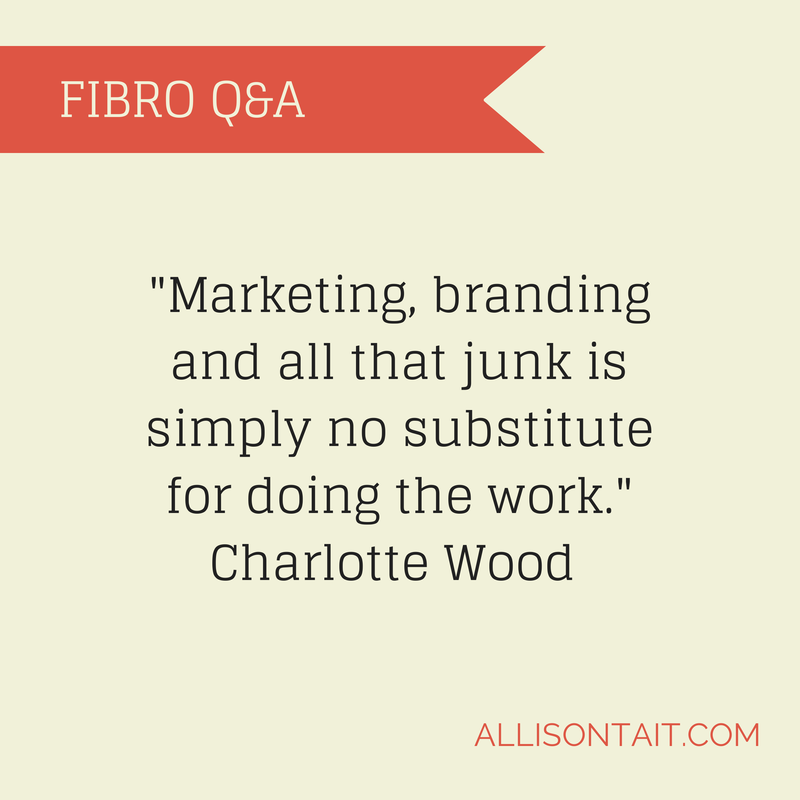
“I understand the seductive power of talk about marketing, and it can be quite pleasurable tinkering about on social media and building websites and blogs and all that, I’ve done plenty of it myself. But I know when I’m using it to distract myself from the real work, which is the writing. Marketing and branding and all that junk is simply no substitute for doing the work.”
What do you think are the biggest challenges facing Australian writers today?
Charlotte Wood: “Declining readership for literary work worries me a bit, but then I try to forget about that and just get on with things. I am extremely lucky to have had my first very odd, small, weird novel published when it was, because I think now that book would never be published.
“I think literary fiction writers, at least, need to face the fact that it is highly unlikely they will ever make a living from writing literary fiction – even one amazing advance doesn’t last long over a lifetime of writing, and Australian writers who command large advances repeatedly can be counted on one hand. But once you face the financial facts and try to align your life to make money in other ways, there is enormous freedom and dignity and rich, profound satisfaction to be found in the writing life.
“The other side of the coin is that the technology available now for digital publishing opens up all kinds of really exciting opportunities and we’re only beginning to see how they will play out.”
You can find more information about Charlotte Wood here at her website.
 Are you new here? Welcome to my blog! I’m Allison Tait and you can find out more about me here and more about my online writing courses here.
Subscribe to So You Want To Be A Writer podcast for more amazing writing advice.
Or check out So You Want To Be A Writer (the book), where my co-author Valerie Khoo and I have distilled the best tips from hundreds of author and industry expert interviews. Find out more and buy it here.

0 Comments